• Home
  • Nepal
  • Other Destinations
  • Blog
  • Company
Chat on Whatsapp

High-altitude treks, real local guides, and straight-up advice from the Himalayas.

TripAdvisor
Lonely Planet

Stay Ahead of the Mountains

Get trek updates, permit alerts, and seasonal tips straight from the Himalayas.

Contacts

Kaldhara-16, Kathmandu, Nepal

Tel: +977 1 5360765

WhatsApp: +977 9841353904

Email: [email protected]

Quick Links

  • Legal Documents
  • Terms & Conditions
  • About Us
  • Favourites
  • Blog

Activities

  • Trekking
  • Tours
  • Jungle Safari
  • Day Hiking
  • Helicopter Tours
  • Jeep Tours

Payment Methods

Payment Method
Payment Method
Payment Method

Recognized By

Association Logo
Association Logo
Association Logo
Association Logo
KEEP

© 2026 Alpine Adventure Club. All Rights Reserved

Built by Bishal

Essential Trip Information

  • Location

    Nepal
  • Region

    Annapurna

Duration

18 days
  • Group Size

    Min. 1 Pax
  • Max Elevation

    5,416 m
  • Difficulty

    Moderately
  • Accommodation

    Hotel/Lodge
  • Best Seasons

    Spring and Autumn
  • Start Point

    Kathmandu
  • End Point

    Kathmandu
  • Permit

    Required
  • Food

    Three Meals/Day
  • Overview of the trek

    The Classic Annapurna Circuit Trek is an unforgettable Himalayan journey that crosses Thorong La Pass (5,416 m) and showcases the diversity of Nepal’s natural beauty and cultural heritage. While roads have been built between Besi Sahar and Manang and from Muktinath to Pokhara so you can start and end your trek wherever you like, many trekkers still prefer to do the full traditional route. This allows them to experience the trek in its entirety.

    Our itinerary starts a bit ahead of the Classic Annapurna Circuit starting point in Syange, about 1.5 hours’ drive from Besi Sahar, for a more scenic and interesting start to the trail. The route covers an impressive range of altitudes—from around 820 meters (2,690 feet) in the foothills to the high alpine regions near the pass—so proper acclimatization is essential for a safe and enjoyable trek.

    Some people shorten the trek and end in Jomsom and fly or drive to Pokhara, but the full Annapurna circuit is more rewarding. Roads have made it possible to skip the lower sections by starting from Chame or ending early from Muktinath. But those who want the real journey go beyond Thorong La Pass and visit Poon Hill (3,210 m), a panoramic viewpoint famous for its sunrise views of the Himalayas.

    Our 18-day itinerary follows the classic route, through changing landscapes—from farmland and subtropical forests to high altitude deserts and glacier carved valleys. Along the way we meet warm and resilient communities like Gurung, Thakali and Tibetan-influenced people.

    After a scenic drive from Kathmandu to Syange, the trail follows the Marsyangdi River Valley, passing through villages like Jagat, Dharapani, Chame, Pisang and Manang where we take a day to acclimatize. From there we ascend to the highest point of the trek Thorong La Pass and then descend to Muktinath (3,800 m), a sacred site for both Hindus and Buddhists.Then the trail enters the dramatic Kali Gandaki Valley, the world’s deepest gorge.

    At Tatopani trekkers can relax in natural hot springs believed to have healing properties. From Tatopani, a steep climb to Ghorepani (2,855 m) and an early morning hike to Poon Hill to see the breathtaking views of Annapurna, Dhaulagiri and Machhapuchhre (Fishtail).

    From there the trail goes through Tadapani and Ghandruk and you can either return back to Pokhara or continue through Landruk, Tolka, Pitam Deurali, Pothana and Dhampus. The trek ends at Dhampus Phedi and then a short drive to Pokhara and back to Kathmandu by bus or flight as per your service.

    Highlights of the Annapurna Circuit Trek

    • Cross Thorong La Pass (5,416 m), the highest point on the trek
    • Experience breathtaking sunrises from Poon Hill (3,210 m)
    • Walk through diverse terrain: lush forests, deep gorges, high-altitude deserts, and glacial valleys
    • Explore vibrant villages inhabited by Gurung, Thakali, and Tibetan-influenced communities
    • Relax in the natural hot springs of Tatopani
    • Visit Muktinath (3,800 m), a sacred pilgrimage site for Hindus and Buddhists
    • Trek through the world’s deepest gorge, the Kali Gandaki Valley

    Trip Itinerary for Annapurna Circuit Trek

    Detailed Day-to-Day Itinerary

    Day 01

    Arrive in Kathmandu

    Duration:
    ~30 minutes
    Accommodation:
    Hotel
    Once you reach at Kathmandu airport, our representative will transfer you to your hotel. A short travel briefing will be given at the hotel/office, and you will be requested to pay the travel dues. Overnight at Hotel

    Day 02

    Kathmandu Sightseeing and trek Preparation

    Duration:
    ~4-5 hours
    Accommodation:
    Hotel
    After breakfast, Kathmandu visits Durbar Square, Pashupatinath Temple, Swayambhunath Stupa, and Boudhanath Stupa which are all World Heritage Sites. Durbar Square throws light on the life of the royals in ancient times. Pashupatinath Temple is one of the most important pilgrimage places for all Hindus. Swayambhunath is also known as Monkey Temple and Boudhanath Stupa is one of the largest stupas in the world. Late in the afternoon, we introduced you to your mountain/trek guide. Overnight at Hotel.

    Day 03

    Drive from Kathmandu to Syange (1,080 m)

    Duration:
    ~8-9
    Accommodation:
    Lodge
    We begin our long drive to Syange early in the morning. En route we get to enjoy the countryside of Nepal with its green hills, winding rivers, terraced farms and of course the mighty Himalayas. The price quoted on our website includes public transportation from Kathmandu to Besi Sahar, from here we have to take another public transportation to Syange. We can also arrange private transportation if you are willing to pay for it. Overnight at Teahouse/Lodge.

    Day 04

    Syange trek to Dharapani (1,960 m)

    Duration:
    ~7-8 hours
    Accommodation:
    Lodge
    From Syange we will start our trek along the peaceful river banks and climb up to the stone village of Jagat (1,330 m). From Jagat our trail descends, crossing Ghatte Khola Stream and climbs again through forest-finally reaching Chamje (1,410 m). From Chamje our path crosses to the east fork of Marsyangdi River. Soon we climb steep stone steps past the village of Sattale (1,680 m), past fields and rhododendrons along the river bank and later climb to the open plateau of Tal (1,700 m). We continue gradually uphill, passing the villages of Khorte and Karte to finally you are reaching at Dharapani (1,960 m). Overnight at Teahouse/Lodge.

    Day 05

    Dharapani trek to Chame (2,670 m)

    Duration:
    ~5-6 hours
    Accommodation:
    Lodge
    Today, we pass a village school and also you can see the way of coming down from Larkya Pass (Manaslu trekking) and continue climb gradually through a forest to the typical Tibetan-style village of Bagarchhap (2,160 m). Remaining along the left bank of the river, we gradually climb to Danaque (2,210 m). After Danaque cross suspension bridge and climb up to Temang village (2600m) and continue trek koto (2,640 m). It is the gate way for Nar Phu valley trekking. After koto easy walk to Chame (2,670 m) the largest village and headquarters of Manang District. Overnight at Teahouse/Lodge.

    Day 06

    Chame trek to Upper Pisang (3,300 m)

    Duration:
    ~5-6 hours
    Accommodation:
    Lodge
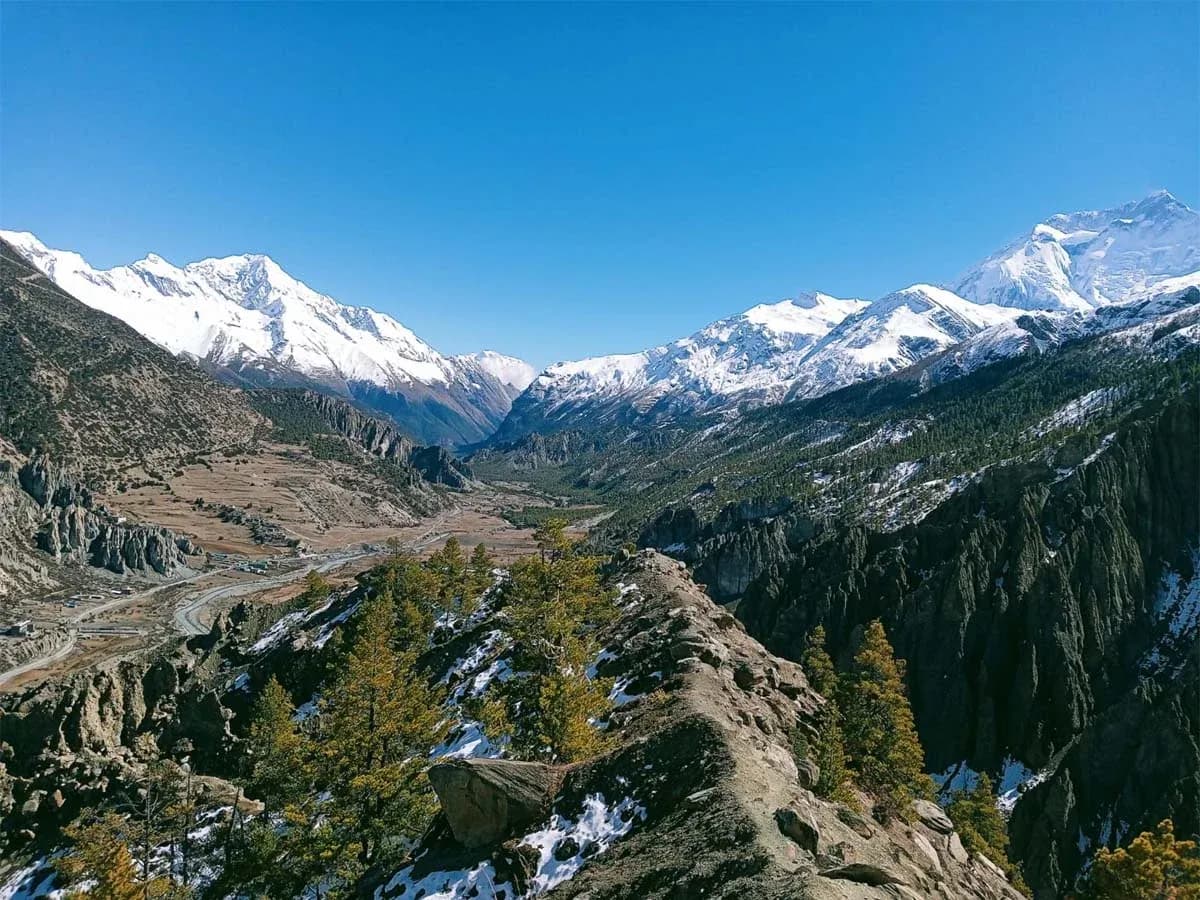
    You will cross Marshyangdi River and enter the forests of pines. The trail enters inside a small valley with gentle ups. You will then meet Bratang village. Walking a little some more from Bratang, You will again have to cross the Marshyangdi river. From here the trail goes steep up before you meet the road to Manang. You will walk on the road for a while then will reach Dhukur Pokhari (Lunch spot). Many mountains, including Annapurna II, Pisang Peak, Chulu Peak, Tilicho Peak, and others, are visible from Dhikur Pokhari. You will next cross a suspension bridge across a river and begin walking toward Upper Pisang. Upper Pisang has magnificent views of the Annapurna Ranges, and Pisang Peak. Due to the thin air at Upper Pisang, some trekkers may have trouble breathing. Overnight at Teahouse/Lodge.

    Day 07

    Upper Pisang trek to Manang (3,540 m)

    Duration:
    ~6-7 hours
    Accommodation:
    Lodge
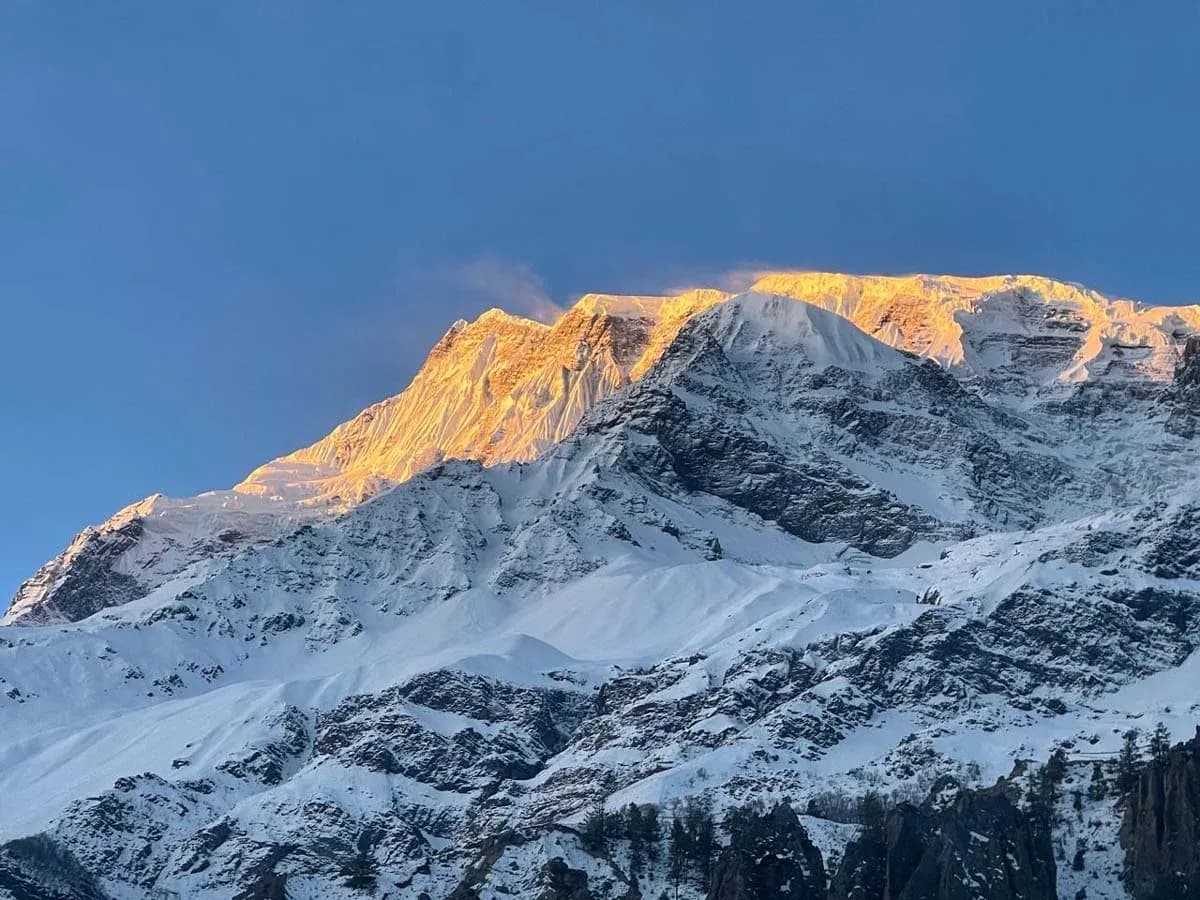
    From Upper Pisang, you will trek on the most difficult trail, which includes several steep climbs and switchbacks. You will trek on the higher trails via Ghyaru and Ngawal, from where you will have magnificent views of Lamjung Himal (6. 983m), Annapurna II (7,937m), Annapurna IV (7,525m), Gandarbha Chuli (6,250m), Annapurna III (7555m), Gangapurna (7,544m), Glacier Dome (7,193m), Khangsar Kan (6,091m). You will notice that the air becomes cooler, drier and harsher as the trail ascends. You will have the opportunity to learn about Buddhist culture as you pass through the Tibetan communities along the way. Before reaching Manang, the trail passes by the picturesque town of Munchi and the obscure hamlet of Braga. The largest monastery in Manang is the Barge Monastery, which you will explore. When you finally reach Manang Bazaar after passing several monasteries, you will notice that the road is decorated with Buddhist shrines. One of the largest settlements along the Annapurna Circuit Trek is Manang. Overnight at Teahouse/Lodge.

    Day 08

    Acclimatization in Manang (3,540 m)

    Duration:
    ~3-4 hours
    Accommodation:
    Lodge
    Today is our like a rest day to acclimatization for trekking in higher elevation but you can make short hike to Praken Gompa (3,945 m), which is not that far from Manang. However, you will have to walk a steep climb to reach the gompa. The view from the gompa is incredible, with magnificent views of Annapurna II, Annapurna IV and Gangapurna etc. In the afternoon, explore Manang village and visit Gangapurna Lake. But if you have time and energy you can add extra days to hike up to Milarepa cave at 4100 meters or Ice Lake (Kicho Valley) at 4620 meters, which is about 15 kilometers round trip from Manang it takes about 6 to 8 hours, it is difficult day hike better consult with your guide before you go, or you need to share you interested before book your trek usually our original plan is not included Milarepa cave and Ice Lake. Overnight at Teahouse/Lodge.

    Day 09

    Manang trek to Yak Kharka (4,110 m)

    Duration:
    ~3-5 hours
    Accommodation:
    Lodge
    The trekking trail now begins an ascent above 1876m to Thorung La from Manang village. From Manang village the trail crosses a stream before climbing to Tengi (3,650 m). We then continue to climb the Marsyangdi valley, passing the small village of Gunsang (3,960 m). After crossing a large stream that flows from Chulu west and Gundang, the trail passes an ancient Mani wall in a pleasant meadow at 4000 m. Beyond here is Yak Kharka, (4,110 m) also known as Koche. Overnight at Teahouse/Lodge.

    Day 10

    Yak Kharka trek to Thorong Phedi (4,420 m)

    Duration:
    ~3-4 hours
    Accommodation:
    Lodge
    After less than one hour walking you are reaching at Chauri Ledar (4,250 m). From Ledar the trail continues to climb along the east bank of the Jorsang Khola, then descends and crosses the stream on a wooden bridge at 4,310 metres. After making a short ascent on a good trail to a teashop, the route then follows a narrow path across a high, unstable slope path before reach at Thorong Phedi (4,420 m). Overnight at Teahouse/Lodge.

    Day 11

    Trek to Muktinath (3,800 m), Over the Thorong La Pass (5,416 m)

    Duration:
    ~7-9 hours
    Accommodation:
    Lodge
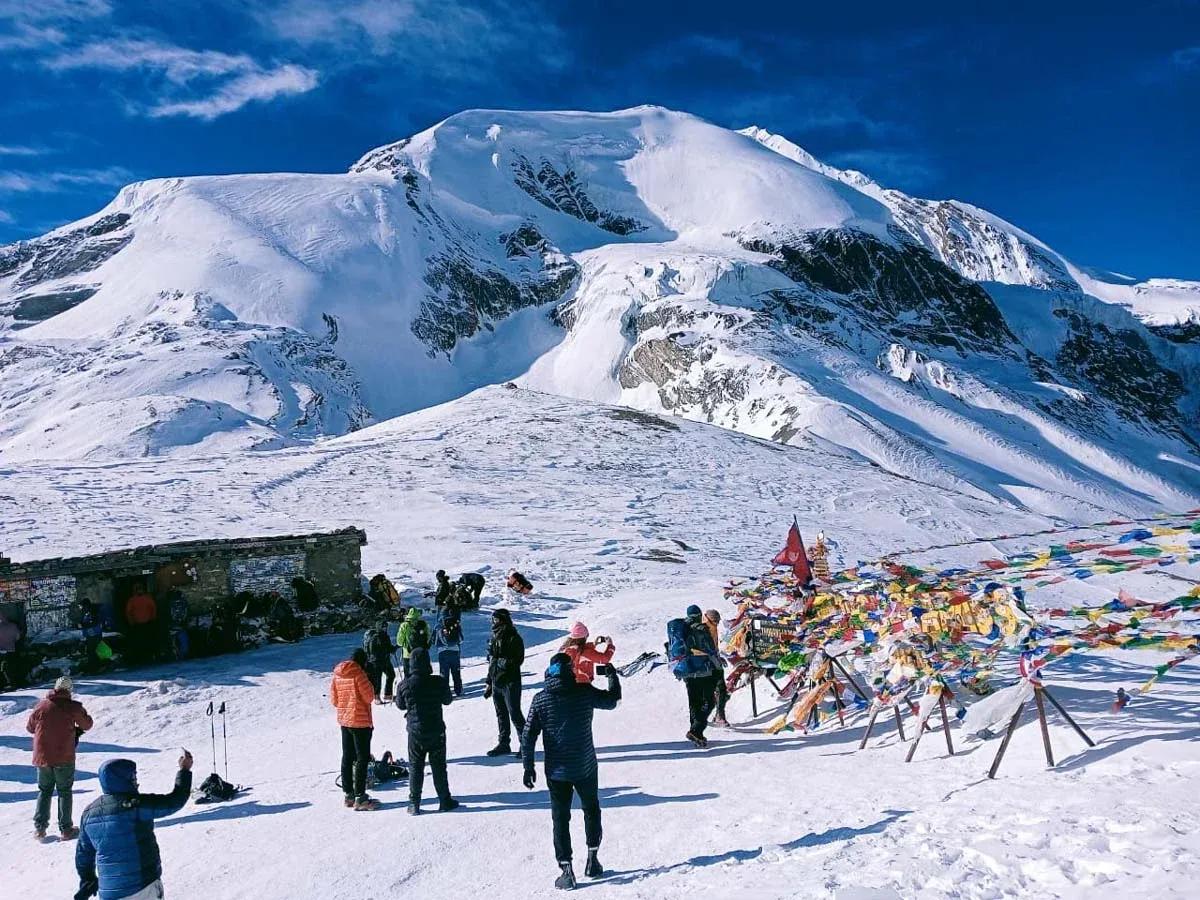
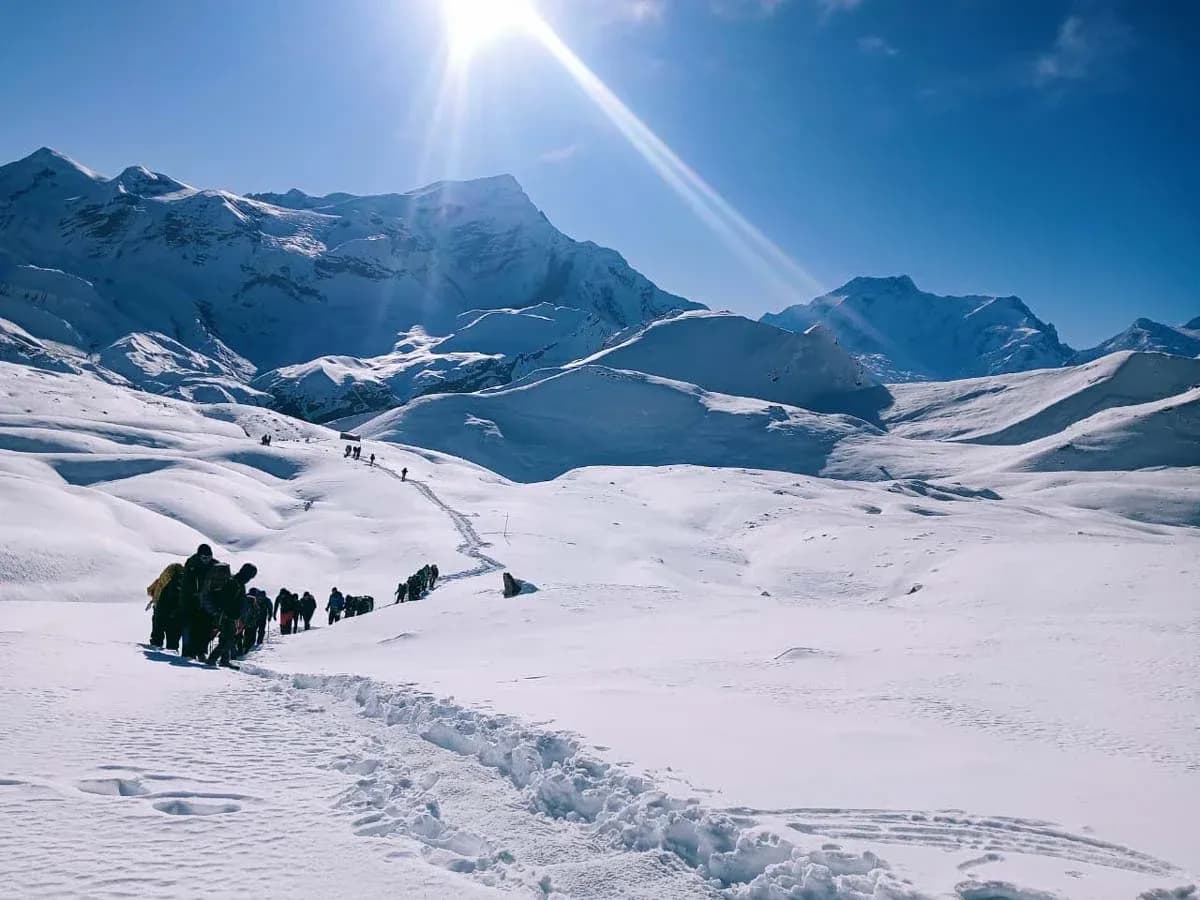
    The set off is exceptionally early in the morning to go across Thorong La Pass at 5416m. The trail becomes steep instantly after leaving Phedi but easy to follow. 4-6 hours ascent leads to the top of the Pass, which is complete with prayer flags, a chorten and stone cairn built by trekkers. At the top of Thorong La there is one tea shop but only running in trekking season time where you will have hot tea/coffee in your small rest at top. The views from the trail and from the pass are majestic. You will see Thorung peak, Annapurnas, Gangapurna, Khatung Kang and Kali Gandaki valley etc. After Thorong La top the trail descends steeply proceeding towards Chabarbu (4,290 m), available tiny seasonable teahouse. From here on, the trail crosses meadows, drops into a deep gorge, climbs out and follows a wide trail into Muktinath, a pilgrimage site held in great reverence by both the Hindus and Buddhists. Overnight at Teahouse/Lodge.

    Day 12

    Muktinath drive by public bus to Jomsom continue to Tatopani (1,190 m)

    Duration:
    ~3-4 hours
    Accommodation:
    Lodge
    You start your overland journey in Muktinath. There are regular public buses from Muktinath to Pokhara. Tatopani is on the way, so we take the public bus or hire a private jeep to drive to Tatopani (depending on which service you have booked). However, if you prefer public bus, you sometimes have to change to another bus from Jomsom. After reaching Tatopani you are free to relax and enjoy bathing in the natural spring. Overnight at Teahouse/Lodge.

    Day 13

    Tatopani trek to Ghorepani (2,855 m)

    Duration:
    ~6-7 hours
    Accommodation:
    Lodge
    Today is another big day. It will take about 6 to 7 hours to hike from Tatopani to Ghorepani. You will climb 1,665 meters. On the way, you will pass some Magar and Gurung villages. Throughout the trek, you will see green fields and excellent views of Mount Dhaulagiri, Tukuche peak and Nilgiri Himal. Ghorepani lies on a hilltop. From Ghorepani, the unparalleled beauty of Dhaulagiri, Annapurna South, Hiunchuli and Tukuche peak is truly extraordinary. Overnight at Teahouse/Lodge.

    Day 14

    Ghorepani Hike to Poon Hill (3,210 m) and trek to Tadapani (2,610 m)

    Duration:
    ~6-7 hours
    Accommodation:
    Lodge
    Today we wake up early and hike to Poon Hill, just in time to see the sunrise over the Himalayas. From Poon Hill, we can view a brilliant panorama of mountain including Dhaulagiri, Tukuche, Nilgiri, Annapurna South, Annapurna, Hiunchuli, Machhapuchhre (fishtail) and many more. After enjoying the view, we return to our lodge for a hearty breakfast and follow a pleasant forest trail uphill through rhododendron and oak forests to Deurali (2960 m). After Deurali, the trail descends through rhododendron forests to Banthanti (2606 m). The trail then climbs and passes through a sugarcane field to Bhurung Khola before climbing again for 20 minutes through steep forests to finally reach Tadapani (2710 m), which offers breathtaking views of the Annapurna ranges, especially Annapurna South, Hiunchuli and Machhapuchhre. Overnight at Teahouse/Lodge.

    Day 15

    Tadapani trek to Landruk (1,545 m) via Ghandruk village

    Duration:
    ~5-7 hours
    Accommodation:
    Lodge
    From Tadapani, we make a steep descent through the dense and dark forest. This part of the trek will be through a thick forest of old rhododendron trees. When the rhododendron trees are in bloom, these forests actually turn into amazing gardens. By afternoon, depending upon the season of travel, we also get to enjoy cherry blossoms in bloom on the slopes on the other side of the ravine. After trekking a few more minutes, we enter the village of Ghandruk, a slope settlement with stone houses mostly inhabited by the Gurung people. Here, we enjoy the stunningly close-up towering views of Fishtail, Annapurna South, and Hiunchuli mountains. From Ghandruk We decent down to Modi Khola and start climb up to Landruk village (1,545 m) a pretty big village inhabited by mixed community of Gurung, Magar and Brahmin as well. Overnight at Teahouse/Lodge.

    Day 16

    Landruk trek to Dhampus Phedi and drive to Pokhara (820 m)

    Duration:
    ~6-7 hours
    Accommodation:
    Hotel
    From Landruk, the trail gently ascends to Tolka (1,700 m) and then ascent and level path to Bherikharka. From here, the trail goes steeply up to Deorali (2,100 m) with a view of different mountain peaks in panorama. Now the trail gradually descends to Pothana passing through different oak forests. After Pothana, the trail is gently descent up to Dhampus, a village mainly inhabited by Gurung. Now you trek through flat land for some distance and steeply descend to Dhampus Phedi. Now you take vehicle to drive from Dhampus Phedi to Pokhara it takes about 35 minutes driving distance. Overnight at Hotel.

    Day 17

    Pokhara drive by tourist bus to Kathmandu (1,350 m)

    Duration:
    ~7-8 hours
    Accommodation:
    Hotel
    It takes about seven hours, while driving from Pokhara to Kathmandu, you head up to Damauli,, Dumre, Muglin and Kurintar where the Nepal's first Cable car is operated to reach to Manakamana Temple. En route, you could enjoy the mountain views, green sceneries, rice terrace fields, vegetable fields and people being engaged in their daily life activities. From Naubishe you climb up to Thankot, the gateway to capital city. You can also fly from Pokhara to Kathmandu, which takes about 25 minutes. Overnight at Hotel.

    Day 18

    Depart Kathmandu

    Duration:
    ~30 minutes
    The trip comes to the end today. If you prefer to extend your trip let us know otherwise we will transfer you to Kathmandu airport. Normally 3 hours before your flight, you are required to check in.
    Personalize Your Experience

    Have your own ideas or special requirements? We're more than happy to tailor the itinerary to match your schedule, interests, and travel preferences. Let us help you create a personalized adventure that's truly yours.

    Customize My Trip

    Pricing Details

    Price Includes

    • Airport pick up and airport drop by private transportation
    • Accommodation in Kathmandu with breakfast (2 and above participants get twin sharing room in 3-star standard hotel)
    • Historical monument city sightseeing with a tour guide
    • Historical monuments city sightseeing transportation by Non A/C Comfortable Vehicle
    • Kathmandu sightseeing/monument visits Entrance fees
    • Accommodation in Pokhara as per the itinerary with complimentary breakfast (2 and above participants get twin sharing room in a tourist standard hotel)
    • Kathmandu to Syange transportation by private vehicle
    • Pokhara to Kathmandu transportation by tourist bus
    • Trekking accommodation in normal Trekkers lodge/Teahouse (2 and above participants get twin sharing room)
    • Three time meals a day during the trekking Breakfast, Lunch, and Dinner/Main course
    • Dessert (Fresh Fruits/Chocolate) after dinner on behalf of the company
    • One Experienced English-speaking, government licensed and ministry of tourism trained trekking guide and his food, accommodation, and salary.
    • Porters carrying your luggage while trekking (Two guests get one porter carrying a maximum of 25 kg of luggage)
    • Dhampus Phedi to Pokhara transportation by private vehicle
    • Annapurna Conservation area project entry fee
    • Insurance for Nepalese staff (Trekking guide and Porters)
    • Nepal Government taxes and office service charge

    Price Excludes

    • Lunch and Dinner during the stay in Kathmandu
    • Extra night accommodation in Kathmandu because of early arrival, late departure, early return from mountain (due to any reason) than the scheduled itinerary
    • International and domestic air tickets
    Important Note

    The pricing is based on our standard plan suited for most customers. We also provide tailored solutions including both Budget and Premium Plans. Feel free to reach out to us directly.

    Gear Up for Your Trek

    Here’s a concise guide of essentials to prepare smartly for your trek.

    • Thermal underwear (top & bottom)
    • Moisture-wicking T-shirts (2–3)
    • Thermal or wool socks (4–5 pairs)
    • Underwear (quick-dry)
    • Fleece jacket or pullover
    • Lightweight wool sweater
    • Insulated jacket (-10°C to -20°C)
    • Waterproof shell jacket with hood
    • Waterproof trousers
    • Lightweight hiking pants (2 pairs)
    • Windproof softshell (optional)
    • Warm hat, sun hat, buff or neck gaiter
    • Gloves (liner + insulated)
    • Sleepwear and casual evening clothes
    • Waterproof trekking boots (broken-in)
    • Camp shoes or sandals
    • Wool trekking socks (3–4 pairs)
    • Sock liners (optional)
    • Duffle bag (60–80L for porter)
    • Daypack (25–35L with rain cover)
    • Backpack rain cover
    • Garbage bags / bag liners
    • Packing cubes or dry bags (optional)
    • Sleeping bag (-10°C to -20°C rated)
    • Sleeping bag liner
    • Trekking poles
    • Headlamp (extra batteries)
    • Water bottles (2 x 1L Nalgene)
    • Water purification tablets or filter
    • Sunglasses with UV protection
    • Dry snacks (energy bars, trail mix)
    • Pocket knife (optional)
    • Altitude sickness meds (Diamox)
    • Blister treatment (moleskin, Compeed)
    • Biodegradable soap & shampoo
    • Toothbrush & toothpaste
    • Quick-dry towel
    • Wet wipes & hand sanitizer
    • Toilet paper
    • Lip balm (SPF) & sunscreen (SPF 30+)
    • Nail clippers, tweezers
    • Razor (optional)
    • Personal first aid kit
    • Prescription medications
    • Electrolyte powder
    • Basic cold/flu medicine
    • Power bank
    • Charging cables
    • Travel adapter (Nepal types C, D, M)
    • Phone / camera
    • Offline maps or trekking guide app
    • Notebook, pen
    • Copies of passport & permits
    • Extra passport photos
    • Cash (Nepali rupees)
    • Passport (original)
    • Travel insurance with high-altitude coverage
    • TIMS card
    • Sagarmatha National Park permit
    • Lukla flight tickets (round trip)
    Important Note

    Sleeping bags and down jackets are available for rent in Kathmandu, while other trekking gear can be easily purchased. At Alpine Adventure Club, we’ll make sure all your essentials are ready so you’re fully prepared for your adventure.

    Frequently Asked Questions

    Overview & Essentials

    Typically, packages include accommodation, meals during the trek, guide and porter services, permits, and ground transportation. Flight costs, insurance, and personal expenses are usually excluded.
    While prior trekking experience helps, most treks are designed to be achievable with average fitness. Some high-altitude treks may require conditioning or preparation beforehand.
    There is no strict age limit, but participants should be reasonably fit. Trekkers above 60 or with health conditions should consult a doctor before the trip.

    Arrival & Visas

    Most travelers require a tourist visa, which can often be obtained on arrival or online. Check your country’s embassy website for up-to-date visa policies.
    Airport pickup is often included in the tour package. If not, taxis or pre-arranged transport options are available and reliable.
    Yes, arriving early is a great way to rest and adjust before your trek. We can help arrange additional accommodations if needed.

    Health & Safety

    Guides are trained in first aid and will assist you immediately. In serious cases, evacuation (often by helicopter) can be arranged. Travel insurance with emergency coverage is strongly recommended.
    Yes, especially above 2,500 meters. Our itineraries are designed with gradual acclimatization and rest days to help prevent it. Drinking water, eating well, and resting are key.
    Yes, all certified guides are trained in altitude awareness, first aid, and emergency protocols to ensure your safety throughout the trek.

    Weather & Temperature

    Spring (March–May) and autumn (September–November) are the most popular trekking seasons with stable weather and clear skies.
    Temperatures can drop significantly at night, especially at higher altitudes. Days are usually moderate, but proper layering is important.
    Yes, extreme weather can cause delays, especially for flights or high passes. We always try to adjust plans safely and flexibly.

    Accommodation & Facilities

    Accommodations are usually in local lodges or tea houses with basic amenities—clean beds, shared bathrooms, and dining halls.
    Some lodges offer hot showers for an additional fee, but availability may be limited at higher altitudes.
    Charging is available in most lodges for a fee. Power supply may be limited or solar-based, so bring a power bank as backup.

    Packing & Gear

    You’ll need layered clothing, good trekking boots, a daypack, a sleeping bag (if not provided), and basic toiletries. A detailed packing list will be shared upon booking.
    Yes, you can rent most essential gear like down jackets, sleeping bags, and poles from local shops at affordable rates.
    Keep your daypack light with only essentials (water, snacks, jacket). The porter will carry your main bag, usually limited to 10–15 kg.

    Trekker Reviews

    Jack Richeson

    Jack Richeson

    Verified

    "This was my first trip to Nepal and my first time trekking. I was only able to spend a short time here and there was a lot that I wanted to do. The Alpine Adventure Club Treks & Expedition group was very helpful in planning my trip to make the most of my time. I went trekking on a small portion of the Annapurna circuit and was very pleased. The days and distances were very manageable for a trekker of my experience. The teahouses were all clean and my guide and porter were friendly and very helpful. They told me a lot of interesting trekking stories and taught me a lot about Nepal. I would definitely use them again on another trek and recommend them to other trekkers."

    Conny and Helmut (Bavaria, Germany)

    Conny and Helmut (Bavaria, Germany)

    Verified

    "Annapurna Circuit - Annapurna Base Camp October/November 2011 We did 25 days long trek and were very happy to have this Alpine Adventure Club, because with our guide and the porter we could enjoy the trek without any trouble. The most time we had a room for two, sometimes with private bathroom and the most time with hot shower. Although the meals were very good. Our guide looks for everything we need and this makes the trip very relaxing. If we come back to Nepal, we plan this, we will chose the same Agency and also the same guide and porter! Thank you for the nice time in Nepal."

    USD $1985/ person
    ℹ️ Limited seats available for selected departures
    Book NowSend an InquiryCustomize Your Adventure
    Nepal visa fee
  • Personal trekking equipment and Clothing
  • Wire Transfer charge or Credit card service charge as company rule
  • Alcoholic beverages, laundry, Telephone calls and all types of hot drinks in Trekking
  • Soft drinks such as cola, mineral water etc
  • Hot water, battery charge and hot shower charge during the trek (If need to pay)
  • Personal nature expenses and Tipping (Tips)
  • High risk medical / travel insurance and First aid kit
  • Expenses resulting from delays beyond our control in case of weather, flight cancellations, or natural calamities
  • Emergency rescue evacuation (if needed)
  • Any other things not mentioned
  • Similar Treks You Might Like